Finding the Sweet Spot: How Voting Period Length Shapes Co‑Op Election Participation

Click image to view full size.
Last Updated on December 30, 2025 by Hannah Seeley
In cooperative elections, boards spend a surprising amount of time debating one deceptively complicated question: How long should members be allowed to vote? It’s not a simple question to answer. Voting window length, or the number of days ballots are open, plays a major role in election participation rates.
Survey & Ballot System data found that both very long optimal voting duration windows (41+ days) and moderate windows (22–30 days) actually outperformed very short and mid-range (31–40 day) windows. This pattern suggests there may be an optimal voting period range – but it isn’t the one many co-ops assume.
In this guide, you’ll learn how voting windows affect election outcomes, what we’ve learned from analyzing 28 co-op elections*, and practical ways to improve co-op election participation rates.
How Do Voting Windows Affect Cooperative Elections?
Voting windows have a direct impact on participation, but they also shape how members perceive the legitimacy of cooperative elections. When members have enough time to participate, they’re more likely to view the process as transparent and equitable, which directly supports stronger election participation rates.
In fact, members who initially overlook early reminders often circle back later, and those with competing commitments appreciate a process that adapts to their availability. This added accommodation is one reason why longer windows correlate with healthier engagement trends.
A thoughtfully chosen voting window also shows you respect members’ time. Co-ops operate within communities where people juggle holiday travel, seasonal workloads, caregiving responsibilities, and unpredictable schedules. When the voting period accounts for these realities by offering enough flexibility for members to vote at their convenience, it boosts their confidence in the system.
What 28 Co-Op Elections Tell Us About Voting Window Length
To understand how voting window length shapes election participation rates, SBS analyzed data from 28 cooperative elections. Across all elections, the average voting window was 31 days, with individual windows ranging from a short 16 days to a lengthy 93 days.
The results reveal clear participation trends in elections – and a few surprises:
- Elections with 21 days or fewer had an average 7% participation rate, with a typical window of 19 days. Short windows often compress member availability, lowering turnout despite frequent reminders.
- Elections with 22 to 30 days performed better, averaging a 10% participation rate and a 26-day window. This range offers an optimal voting duration for co-ops that want stronger engagement without extending the process too much.
- Elections with 31 to 40 days saw participation dip to just 6%, despite an average window of 33 days. This range is just long enough for members to procrastinate, but not long enough to recapture their attention.
- Surprisingly, elections with 41+ days delivered the highest participation rate at 15%, with an average window of 57 days. These longer windows create more opportunities for outreach and reminders, supporting sustained engagement.
Overall, the data suggest an interesting curve. Participation initially rises with modest increases in the voting period, dips in the mid-range, and climbs again once windows reach 41+ days.
For co-ops seeking an optimal voting period, very long windows (41+ days) perform best. But if that’s too lengthy for your needs, the 22–30 day range is the second-best option.
4 Practical Recommendations for Boosting Co-Op Election Turnout
Voting windows have a huge impact on member engagement, but they also affect how you promote the election. Follow these strategies to increase election participation rates for your co-op.
Consider Communication
Communication is one of the strongest levers for shaping election participation rates. Still, the timing of those messages should align with your voting window length. Clear deadlines, transparent instructions, and early education help members understand the process, reducing confusion and minimizing post-election disputes.
Outreach should also adapt to the window itself: shorter windows require more urgent, concentrated messaging. Longer voting duration windows benefit from staggered reminders that keep momentum high without overwhelming members.
Create an Engagement Campaign
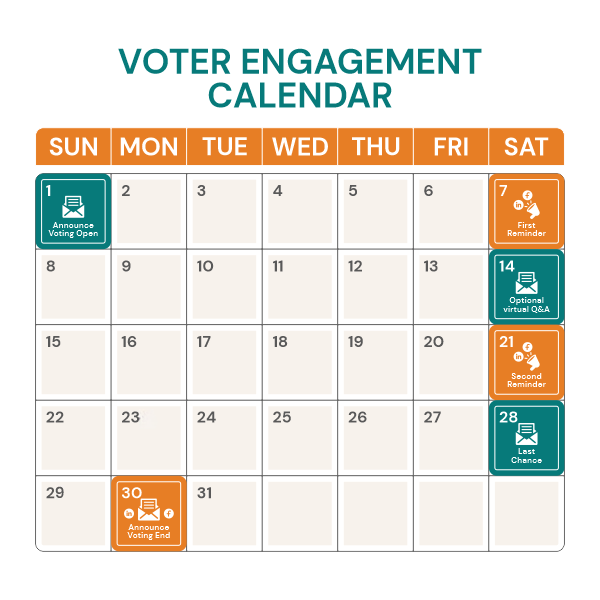
A strong engagement campaign maintains momentum throughout the voting window. Start with a launch announcement that clearly explains the process, follow with mid-period touchpoints such as quick updates or Q&A videos, and close with last-chance reminders that reinforce deadlines. These steady interactions help sustain interest throughout the entire voting period and support voter participation.
Here’s an example of what an engagement campaign looks like, based on a 30-day window:
- Day 1: Announce that voting is open via email, a postcard, and a website banner. Explain how to vote, deadlines, and what’s on the ballot. Include a direct link to the ballot, plus resources for questions and troubleshooting.
- Day 7: Send the first reminder via email and social media. Reinforce the importance of participating and highlight early turnout numbers to spark momentum. Provide FAQs or a short “How to Vote” video. An embedded login link that takes members directly to the ballot will also make it much easier for them to cast their votes.
- Day 14: Touch base again via email, with an invitation to an optional virtual Q&A session. Encourage members who haven’t voted yet to take a few minutes to submit their ballots.
- Day 21: Send a second reminder via email, text, and social media with messaging like, “Only one week left to cast your vote.” Mention all voting options, plus FAQs or support options.
- Day 28: This is the “last chance” message. Alert members via email or a website banner with a high-urgency reminder to vote. Add a countdown clock to your website for a sense of urgency.
- Day 30: Send a text or email with an urgent call that voting ends at midnight. Provide a support phone number for any last-minute questions.
If you’re using a voting platform, it can streamline communication by only sending reminders to people who haven’t voted yet. This setup reduces unnecessary messages and keeps members’ inboxes clear.
Offer Multiple Voting Options
When members can choose the method that fits their lives, overall engagement trends improve across the entire voting period. Providing multiple voting channels helps accommodate members’ preferences and schedules. Consider options like online ballots, mailed paper ballots, or in-person voting. This flexibility ensures the voting window length works for everyone, improving accessibility and increasing voter participation.
Set Up Secure Online Voting
When the voting window extends over several weeks, the security of your online system becomes even more important. If you offer online voting (which is always a good idea, if allowed in your area), you need a compliant platform to manage the election.
A reliable, encrypted platform protects member data, ensures ballot integrity, and maintains confidence throughout the entire voting period. Strong security practices also reinforce trust, which directly supports healthy election participation rates – especially in longer windows where ballots remain open for extended periods.
Better Timing, Better Elections
The data is clear: voting window length has a measurable impact on election participation rates. While not all co-ops can run longer elections, understanding these voting patterns will help you create elections that support accessibility and higher turnout. After all, when the process is inclusive and transparent, engagement trends rise – and so does member trust in the election.
Still, all cooperatives are different. Get expert help not just with choosing a voting window, but with managing every aspect of the election process with Survey & Ballot Systems. See how we help co-ops plan a turnkey election from start to finish.
About this Analysis
*Disclaimer: This analysis is based on a review of 28 cooperative elections conducted by Survey & Ballot Systems between January and October 2023, utilizing a mix of voting methods including paper-only, online-only, and hybrid (paper and online) approaches. While our findings highlight the correlation between voting period length and voter participation, it’s important to note that participation rates are influenced by multiple factors including time of year, ballot content, available voting options, and concurrent local and national events. Additionally, organizations should carefully review their bylaws for specific requirements or restrictions that may limit or impact how they can conduct their elections. The insights shared should be considered as part of a broader strategy to enhance member engagement in cooperative elections.

Tina joined the SBS team in early 2024 as a Marketing Specialist. Her passion for marketing, communications, product management, and customer service hails from a diverse background in health and wellness. As an award-winning product manager, Tina brings a wealth of experience to the team and a broad perspective to help our clients succeed in their elections.