Chain of Custody for Paper Ballots: A Guide for Hybrid Elections
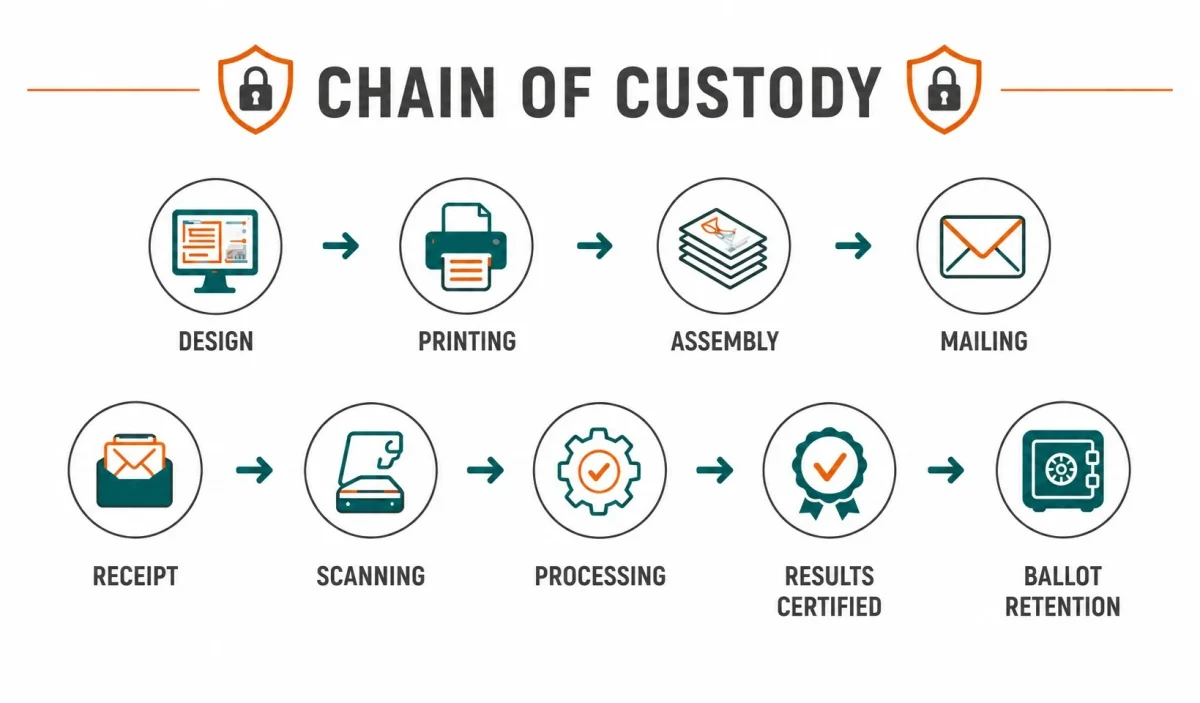
Click image to view full size.
Last Updated on August 25, 2026 by Hannah Seeley
Chain of custody for paper ballots is a must-have for compliance and voter trust, but implementing it isn’t always simple. Associations should implement a structured process that accounts for:
- Secure printing
- Mailing and distribution
- Ballot receipt and processing
- Tabulation and exception handling
- Secure retention and destruction
Hybrid elections give voters more flexibility, but they also mean managing two very different voting methods. You can track online ballots digitally, but physical ballots pass through a lot of hands before you count them.
How can you make sure every paper ballot is secure and accounted for along the way?
You need a transparent chain of custody for paper ballots – and that requires a documented process. With a proper chain of custody, you protect ballot integrity at every stage, from printing and mailing to tabulation and even retention. Plus, chain of custody can also help during audits or if there are any questions about an election.
Still, chain of custody isn’t easy to maintain, especially as your association grows. That’s why having a proven process matters. SBS has processed over 3.9 million paper ballots, giving our team firsthand insight into what it takes to keep ballots secure. In this guide, we’ll share that experience through a practical framework for creating a secure chain of custody SOP for your association. We’ll also share how solutions like Survey & Ballot Systems help you build a traceable process from start to finish.
What Is Chain of Custody for Paper Ballots?
Chain of custody for paper ballots is the process of tracking votes from distribution through counting and long-term storage. Instead of handing off ballots to anyone on your admin team, chain of custody ensures:
- Only authorized people handle the ballots
- Ballots were stored securely at all times
- Documentation every time ballots change hands
- You follow all requirements and safeguards in your bylaws
That matters in any paper-based election, but it’s especially important in a hybrid election where some members vote electronically and others cast paper ballots. Online voting platforms create secure records of voting activity, but paper ballots need the same level of accountability, which is why every association needs a ballot chain of custody SOP.
Having standard operating procedures in place will help you:
- Create documentation: Don’t let an audit catch you by surprise. Having a chain of custody in place creates a much-needed paper trail you can use if there’s ever a concern about an election.
- Protect hybrid elections: When members can choose between paper and electronic voting, administrators need processes that prevent ballots from being lost, mishandled, altered, or counted incorrectly. Chain of custody also ensures members only cast votes once.
- Build trust with members: Voters don’t know what happens behind closed doors when they cast a paper ballot, which can lead to mistrust. A documented chain of custody gives election administrators a clear, repeatable process for explaining how they protect ballots.
Ultimately, chain of custody is about accountability. Paper ballots don’t have the same amount of visibility as digital votes, but that doesn’t mean they’re untrackable. Following a solid election ballot security process ensures traceability and provides the much-needed transparency that your voters deserve.
5-Step Ballot Chain of Custody SOP Framework
Chain of custody isn’t an informal routine. You need a structured process that leaves as little room for uncertainty as possible. Use this framework to build a chain of custody SOP your team can follow for every election.
1. Start With Secure Ballot Design
It might sound surprising, but the chain of custody starts before voters even receive their ballots. You need to ensure continuity before ballots go to print, which means:
- Reviewing content: Look at all ballot content and voter files before sending them to the printer. Use version-controlled proofs so you don’t accidentally send an outdated draft to production.
- Securely transferring files: Security starts with protecting your ballot print files. Whether you print ballots internally or send them to a vendor, only use secure, encrypted file transfer methods. You should also share file access on an as-needed basis instead of making it available to anyone.
- Performing quality control after printing: Never assume printed ballots are perfect. Always double-check that the printed materials match your approved proofs.
It might seem a little early to worry about chain of custody because the ballots are blank, but careful planning at this stage can prevent headaches down the line.
2. Consider Mailing and Distribution
Once ballots leave the printer, the chain of custody should account for how they’re assembled and distributed to voters. That means:
- Verifying addresses: If you haven’t double-checked your voter list for accuracy, now’s the time to do it. You should also work with your mail house to ensure addresses are formatted correctly to help prevent mailing delays. For example, as part of SBS’s standard process, First-Class election mailings of more than 500 pieces are sorted and verified against the National Change of Address (NCOA) database. SBS also provides clients with address samples to review and approve before mailing.
- Checking packet assembly: Chances are, you’re sending members a packet of materials with each ballot. Depending on the election, that packet might include an Annual Meeting Information Statement (AMIS), candidate bios, bylaw information, financial materials, and voting instructions. Before mailing, verify that every packet contains the correct materials. At the same time, keep packets as streamlined as possible to reduce assembly errors and make the information easier for voters to navigate.
- Monitoring with barcodes: If available, add 2D barcodes to your envelopes. This helps verify counts and can even simplify mail assembly.
- Adding outbound mail tracking: Outbound mail tracking gives you greater visibility into ballot delivery and peace of mind that election materials are reaching your members. It can also help you identify potential mail delays early enough to respond. For example, an SBS-managed cooperative election in spring 2026 achieved a 99.67% deliverability rate, with 83% of ballots delivered within two days and 96% within three days of mailing.
- Accounting for mail delays: In the 2024 national US election, the USPS reported that 97.73% of ballots arrived within three days. Still, delays do happen, so give voters as much time as possible to send in their ballots before voting closes.
3. Have Processes for Secure Ballot Receipt and Processing
Most people think the chain of custody starts at this stage, when paper ballots come back to you for processing. While the process starts much earlier, you need plenty of controls in place for receiving ballots securely. Every association needs a consistent process for logging return ballots as they arrive and moving them to an area with controlled access.
Access to returned ballots should be limited to authorized election personnel. Your SOP should document who can receive, handle, transfer, and process ballots, as well as when those activities occur. This gives you a consistent process for every election while limiting unnecessary ballot handling.
4. Tabulate Votes and Handle Exceptions
Are you tabulating paper ballots with spreadsheets or old-fashioned paper tallies? That leaves too much room for error. The best approach is to log paper votes in a secure hybrid voting system that brings both voting methods into a single view.
For example, Survey & Ballot Systems brings digital and paper votes into a single system, with the process handled for you.
Paper ballots can also introduce exceptions that need more review, including:
- Damaged ballots
- Scanning machines not picking up voter selections
- Marks that are hard to read
- Ballot packages marked as undeliverable
Duplicate votes in hybrid elections are also a concern. Sometimes members will vote via paper and digitally (often by accident), so you need procedures to establish which response will take precedence. Keeping both paper and web responses in one system makes it easier to identify duplicate votes before you finalize election results.
Don’t wait for these situations to happen to decide what counts. Establish predetermined rules for accepting or rejecting ballots before voting begins. For each type of discrepancy, document the issue and identify who has the authority to resolve it. This is especially important when a decision could affect whether or how a ballot is counted.
5. Plan for Secure Retention and Destruction
The chain of custody doesn’t end after you count the votes. You need to retain paper ballots for audits or if there’s a challenge to election results. Make sure your SOP outlines what happens to ballots after the election.
Start by consulting your bylaws and policies to see if you have any retention requirements. These vary a lot by organization; for example, financial institutions usually need to retain materials for seven years or more.
Whatever the retention period is, ballots need to be protected from unauthorized access during that time. Fortunately, you don’t need to find the storage space in your office. SBS can store retained election materials in a secure, locked area and inventories them to locate everything if you ever need those records.
But what happens after retention? Your SOP should address how to get rid of sensitive information. For SBS-managed elections, Shred Right securely destroys your on-site materials after the retention period ends. This saves you the hassle of shredding potentially hundreds of pieces of paper while providing the peace of mind that your election materials are still secure.

Better Hybrid Election Paper Ballot Management with SBS
Your voters love having the option to vote online or with a paper ballot, but this hybrid approach requires a different election setup. SBS takes that work off your plate with documented, auditable chain of custody controls throughout the voting process.
Survey & Ballot Systems safeguards your ballots at every stage:
- End-to-end ballot tracking: SBS covers the entire process, including ballot design, printing, assembly, mailing, receipt, scanning, processing, and reporting, so there’s accountability from start to finish.
- Restricted ballot access: We handle paper ballots in secure environments and limit access to authorized personnel only.
- Documented processing: All SBS employees provide their user IDs and sign off when they open, batch, scan, review, and process your ballots. We track every step of the process so you get an incredibly detailed audit trail.
- Daily reconciliation: Your SBS team logs ballots by the date we receive them, but you also get daily paper and web response counts. Instead of worrying whether you’ll get enough votes by the election deadline, SBS provides crucial visibility across all of your voting methods as votes come in.
- Ongoing quality assurance: We don’t take your trust lightly. That’s why our quality assurance specialists periodically review ballot processing to confirm we maintained the chain of custody for paper ballots.
The result is a clear, traceable process for paper ballots that doesn’t require you to build internal controls yourself. Whether your members vote by mail, online, or through a combination of both, SBS helps you maintain the documentation and oversight needed to run a well-managed hybrid election.
Protect Every Ballot From Start to Finish
Hybrid elections give you the best of both worlds: the immediacy and convenience of digital voting and the familiar option of voting with pen and paper. Still, you need a clear process for protecting paper ballots at every stage, not just during tabulation but also during printing, mailing, and retention.
Chain of custody for paper ballots provides the accountability you need. But you don’t have to manage everything yourself. Survey & Ballot Systems can manage both the paper and online sides of your hybrid election, with documented controls and experienced election professionals supporting the process from start to finish.
See how simple hybrid voting can be: Contact SBS today to plan your next election.
Does chain of custody protect ballot secrecy?
Yes, it should. Chain of custody focuses on keeping ballots secure by documenting how they’re handled, including maintaining voter anonymity. However, you do need a few additional safeguards to keep voter identities separate from their selections, like using voter IDs in lieu of voter names.
What happens if a paper ballot has an unclear mark or is damaged?
Every association has different ways of managing these problems. Some will toss out the ballot, while others will reissue a new ballot to the voter. However you choose to handle these exceptions, you need to document the decision formally so you apply the rule consistently. You also need to record the resolution so there’s an auditable record of how the ballot was handled.
How long should organizations retain paper ballots and election records?
It depends on your bylaws and state laws. If you manage an election with SBS, we retain ballots in a secure area for your desired length of time, after which we either destroy them or return them to you for safekeeping.

Tina joined the SBS team in early 2024 as a Marketing Specialist. Her passion for marketing, communications, product management, and customer service hails from a diverse background in health and wellness. As an award-winning product manager, Tina brings a wealth of experience to the team and a broad perspective to help our clients succeed in their elections.